ServicesUSDA Loans
USDA Loans in South Fulton
USDA guaranteed financing lets you buy the place you will live in without putting money down, provided the address is in a USDA-eligible area and the income of everyone moving in stays under the county limit. We run both checks first, explain the fees and point you elsewhere when another loan fits better.
What a USDA Loan Is and When It Fits
Under the USDA Section 502 Guaranteed program, an approved lender writes a 30-year fixed-rate mortgage and the U.S. Department of Agriculture backs part of it. Because the agency carries some of the risk, the loan can cover the full purchase price. That backing is not free: you pay an upfront guarantee fee and an annual fee spread across your monthly payments.
Eligibility turns on two checks, and credit is not one of them. First, the address must sit inside an area the agency's map marks as eligible. Second, total income from every adult moving in must come in at or under the limit for the county and the size of the family. Plenty of addresses around a big metro fall outside the map, so we confirm the exact address before you get attached to a listing.
When the address or the income falls short, you hear it on the first call, along with how FHA loans, VA loans or a low-down-payment conventional loan would compare.
Our Work on Your USDA File
- Map check on the exact address
- Before you get attached to a listing, we look up the specific property, or every area on your shortlist, on the USDA eligibility map. Boundaries run address by address, so two streets side by side can land on opposite sides of the line.
- Income limit math
- The program counts earnings from each adult living in the residence, even people who will not be on the note. We add it up the way USDA does, then take out allowed deductions for dependents, childcare and certain medical costs.
- Credit and debt-ratio review
- Once credit is pulled, we measure the proposed housing payment and your total monthly debt against gross income. If a ratio runs high, we name the debt causing it and what would bring it down.
- Pre-approval through GUS
- Most USDA files run through the Guaranteed Underwriting System for an automated decision. An accept result stands behind the pre-approval letter your agent includes with an offer.
- Appraisal and agency review
- We order the appraisal and clear our own underwriting, and then the completed file goes to USDA for a second review before the guarantee is issued. We track that agency review closely so it does not push back your closing date.
Signs a USDA Loan Could Be Your Best Option
Savings would not cover a down payment
The monthly payment is comfortable, but a big lump sum is not sitting in the bank. USDA financing asks for nothing down.
You are shopping outside the dense core
Listings toward the outer edges of the metro are on your list, and that is where eligible areas show up most. One address check sorts qualifying listings from the rest.
Your income is moderate, not high
USDA sets an income ceiling, which shuts out many higher earners. Families earning in the middle range are the ones the program was built for.
You want a fixed payment for 30 years
Guaranteed USDA loans carry a 30-year fixed rate. Principal and interest stay the same from the first payment to the last, which keeps long-range budgeting simple.
FHA mortgage insurance looks steep
USDA's yearly guarantee fee tends to cost less per month than FHA mortgage insurance premiums. We run both payments next to each other so you compare real numbers.
What Moves the Cost of a USDA Loan
Skipping the down payment still leaves real costs to cover. What you pay comes down to the program fees, your rate and the closing costs on the purchase. Each one shows up as its own line on a written estimate, so nothing is buried.
Guarantee fees
The agency charges an upfront guarantee fee, which most buyers roll into the loan, plus an annual fee collected with each monthly payment. USDA sets both rates. We do not.
Your interest rate
Your credit score, market conditions on the day you lock and the size of the loan all shape the rate. Higher scores generally get better pricing.
Closing costs and seller help
You still pay for title work, the appraisal, recording and prepaid items. A seller can put money toward those costs, and when the appraisal comes in above the sale price, part of them can be financed.
Taxes and insurance escrow
Property taxes and the hazard insurance premium are collected each month through escrow. If either one goes up, your payment rises even though the rate has not moved.
How a USDA Loan Moves From Call to Closing
- 1
Free consultation by phone
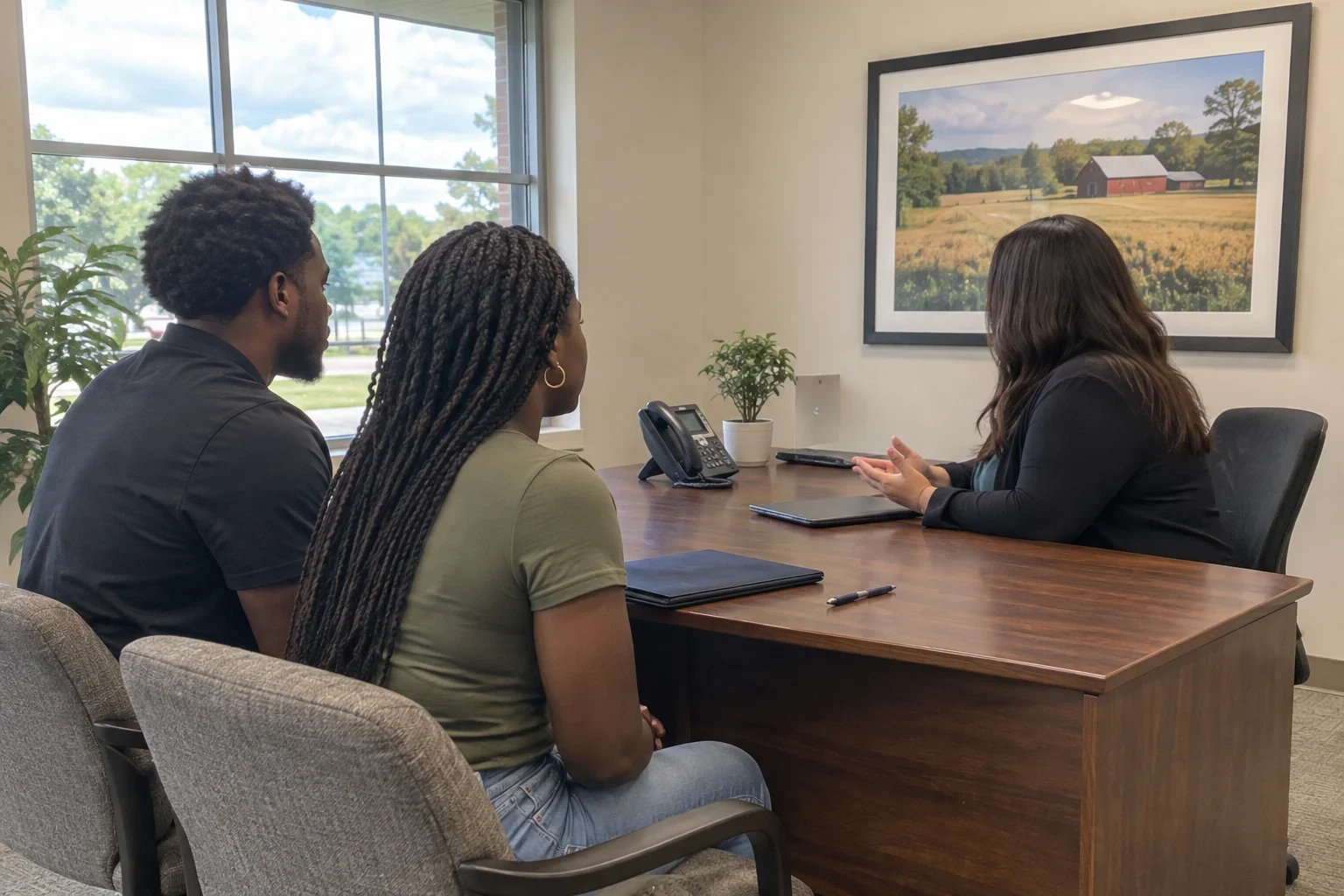
Everything begins with a scheduled callback from a loan officer. We talk through the address or areas you like, who will live with you and a rough income figure, then tell you plainly whether USDA is realistic.
- 2
Documents and pre-approval
You gather recent pay stubs, W-2s or tax returns, and bank statements. We run the file through GUS, measure it against the income limit and put your pre-approval in writing.
- 3
Accepted offer and appraisal
Once you have a signed purchase contract, we order the appraisal, which looks at value and basic property condition. Our underwriter clears the remaining conditions, and the package then goes to USDA for its guarantee review.
- 4
Closing
Closing is scheduled once USDA issues its commitment. The Closing Disclosure reaches you at least three business days before signing, so no figure appears for the first time at the table.
USDA Loan Questions
Is a USDA loan only for farms or rural land?
No. It finances regular single-family residences in eligible areas, subdivisions included. Working farms and land meant to produce income do not qualify. You also have to live in the property as your primary residence.
What credit score do I need?
USDA does not set a hard floor. In practice, most lenders and most GUS accept results involve scores in the mid-600s or higher. A lower score can sometimes go through manual underwriting if the rest of the file is strong. Once we pull credit, we tell you which side of that line you are on.
Why does my roommate's or parent's income count?
The program counts income from everyone 18 or older living in the property, whether or not they sign the loan. Qualifying for the payment itself uses only the borrowers' income. Buyers are often surprised by that split, so we work through it on the first call.
How long does it take to close on a USDA loan?
Expect a longer runway than with a conventional mortgage, since USDA does its own review once our underwriting is done. Build extra days into the contract. We share how quickly USDA is turning files when you lock, so your agent can set dates that hold.
Can I refinance a USDA loan later?
Yes. Existing USDA loans have streamlined refinance options, and once you have built equity you can also move into a conventional loan. Our mortgage refinance page covers when each path makes sense.
Find Out if Your Address and Income Qualify
Tell us the property or the area you are shopping, plus a rough income number. We set a time, a loan officer calls you then, and you get a clear yes, a clear no or a better option.